
Reviewed by Dr Pipin Kojodjojo, consultant cardiologist specialising in cardiac devices at Asian Heart & Vascular Centre. Last reviewed August 2026.
Reading time: about 11 minutes.
TL;DR
A pacemaker is a small implanted device that steps in when the heart’s own electrical system fails to keep the rate up. It does not speed up a normal heart, and it does not treat blocked arteries. The two conditions behind most implants are sinus node dysfunction, where the heart’s natural timer becomes unreliable, and heart block, where the signal fails to reach the pumping chambers. Nearly 1,000 cardiac devices are implanted in Singapore each year. The decision to implant rests on whether a slow rate is causing symptoms, and on whether a reversible cause has first been ruled out.
What a pacemaker does, and what it does not do
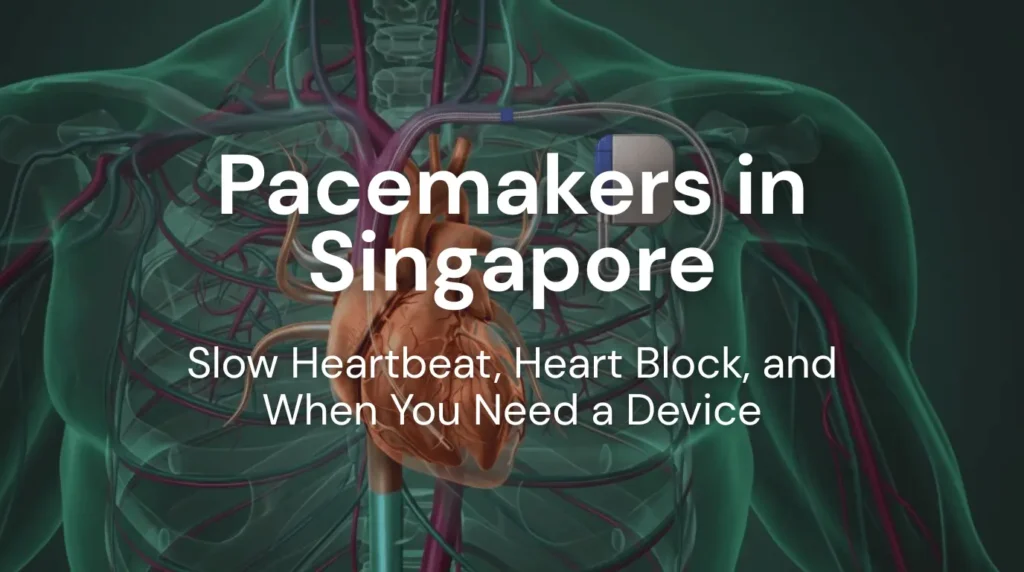
A pacemaker is a device roughly the size of a large coin, placed under the skin below the collarbone, connected to the heart by one or two thin insulated wires called leads. It watches every beat. When the interval between beats grows too long, it delivers a small electrical impulse that prompts the heart to contract.
The important thing to understand is how narrow that job is. A pacemaker sets a floor, not a ceiling. It will not allow the rate to fall below the programmed minimum, and it does nothing at all while your own rhythm is behaving. Many patients with a pacemaker are being paced only a small fraction of the time.
Three things a pacemaker does not do, all of which patients commonly assume it does:
- It does not open blocked arteries. That is a separate problem treated with medication, a stent, or bypass surgery. A pacemaker does not affect coronary disease.
- It does not stop a fast or irregular rhythm. Atrial fibrillation (an irregular heartbeat originating in the upper chambers) is not treated by pacing. A pacemaker is sometimes fitted alongside treatment for a fast rhythm, but it is addressing the slow side of the problem, not the fast side.
- It does not shock the heart. That is a different device, an implantable cardioverter defibrillator, covered further down.
A common misconception worth naming directly. Patients often assume a pacemaker means their heart is failing. It usually does not. The commonest reason for a pacemaker is a conduction problem, a fault in the heart’s wiring, in a heart whose pumping muscle is working normally. The two are separate systems, and they fail independently.
The symptoms that lead to a pacemaker assessment
Most people referred for a pacemaker assessment arrive with one of a small number of complaints, and the pattern matters more than any single episode.
- Fainting or near-fainting (syncope), particularly without warning. A blackout with no preceding nausea, sweating or tunnel vision is more concerning than one with a clear build-up, because it suggests an abrupt electrical pause rather than a gradual drop in blood pressure.
- Breathlessness on mild exertion that has come on over weeks or months, especially where the pulse does not rise as expected during activity.
- Unusual tiredness out of proportion to the day, sometimes described as the body feeling heavy or slow rather than sleepy.
- Dizziness or light-headedness, often on standing or on exertion.
- Chest discomfort or palpitations, sometimes reported as the heart feeling as though it pauses or misses.
- Reduced exercise tolerance, where activities that were comfortable last year now require rests.
Two patterns catch patients out. The first is that a slow heart rate can produce no symptoms at all, and be found incidentally on an electrocardiogram (ECG) taken for another reason. The second is the reverse: patients attribute months of fatigue to age or work, and only in hindsight recognise how limited they had become.
If symptoms include a blackout with injury, chest pain at rest, or breathlessness that comes on suddenly, the correct step is emergency assessment rather than a clinic appointment.
Why the heart’s rhythm slows: the two problems behind most pacemakers
Every normal heartbeat starts in the sinus node, a small cluster of cells in the right atrium that acts as the heart’s timer. The signal spreads across both upper chambers, passes through the atrioventricular node, and travels down specialised conducting fibres to the ventricles, the two pumping chambers. Pacing becomes necessary when that sequence fails in one of two places.
Sinus node dysfunction, also called sick sinus syndrome, is a failure of the timer itself. The node fires too slowly, pauses, or fails to speed up on exertion. Where the rate is appropriate at rest but does not rise with activity, the pattern is called chronotropic incompetence, and it presents as breathlessness and fatigue on exertion rather than as blackouts.
Heart block, also called atrioventricular block, is a failure of transmission. The signal leaves the atria correctly but is delayed or fails to reach the ventricles. It is graded by severity. First-degree block is a consistent delay and rarely needs treatment. Second-degree block means some signals are dropped, and the significance depends on which type. Third-degree block, also called complete heart block, means no signals get through, and the ventricles fall back on a slow intrinsic rhythm of their own. Complete heart block is the clearest indication for a pacemaker there is, and current guidelines recommend implantation whether or not the patient has symptoms.
Both problems become more common with age, as the conducting tissue gradually becomes fibrous. That is why the ageing population matters here: Singapore’s implant volumes have been expected to rise for the same reason.
Do you need a pacemaker? How the decision is actually made
This is the question most patients arrive with, and the honest answer is that it turns on three things, in this order.
First, is the slow rate causing symptoms? For sinus node dysfunction, this is the deciding question. Symptomatic bradycardia (a slow heart rate producing fainting, breathlessness, or fatigue) that is clearly linked to the rhythm is an indication for pacing. An incidental slow rate with no symptoms usually is not. Resting heart rates in the 40s and 50s are normal in trained endurance athletes and in many people during sleep, and pacing a healthy athlete because of a number on a report would be the wrong decision.
Second, is there a reversible cause? This step is skipped more often than it should be, and it changes the answer entirely. Beta-blockers, rate-limiting calcium channel blockers, digoxin and some antiarrhythmic drugs all slow conduction, and stopping or reducing the drug may resolve the problem without any device. An underactive thyroid, electrolyte disturbance, untreated sleep apnoea, and acute ischaemia can each produce reversible bradycardia. Guidelines are explicit that reversible causes should be identified and corrected before a permanent device is considered.
Third, is the type of block itself dangerous? Some patterns warrant a pacemaker regardless of symptoms, because the risk is of an abrupt pause rather than a gradual decline. Complete heart block is the clearest example.
What the assessment involves. A resting ECG confirms the rhythm at that moment, which is often not enough on its own, because intermittent problems hide between recordings. A Holter monitor worn for 24 to 48 hours, or a longer-wear patch monitor, extends the recording window. Where symptoms are infrequent, an implantable loop recorder, a small device placed under the skin that records for up to three years, is used to catch an event that external monitors keep missing. An exercise test is useful where the question is whether the rate rises appropriately on exertion. An echocardiogram (a heart ultrasound) assesses the pumping muscle, which shapes which device is appropriate. Blood tests check thyroid function and electrolytes.
Being honest about the limits. A pacemaker reliably prevents symptoms caused by a slow rate. It does not improve symptoms that were never caused by the rhythm in the first place, which is why establishing the link between the rhythm and the symptom matters so much before implanting. If breathlessness turns out to be lung disease or anaemia, a pacemaker will not help it.
The devices, and which one matches which problem
The word “pacemaker” covers several distinct devices with different jobs. Blurring them is the most common source of patient confusion, so it is worth being precise.
- Permanent pacemaker (PPM). For sinus node dysfunction and heart block. Prevents the rate from falling too low.
- Implantable cardioverter defibrillator (ICD). For prevention of sudden death from a dangerous fast rhythm arising in the ventricles. Delivers a shock. Also paces.
- Cardiac resynchronisation therapy (CRT-P or CRT-D). For heart failure with a weakened, electrically delayed left ventricle. Coordinates the two ventricles.
- Implantable loop recorder (ILR). Diagnosis, not treatment. Records rhythm for up to three years to catch infrequent events.
Within permanent pacemakers, the main distinction is how many chambers are paced. A single-chamber device paces one chamber, usually the ventricle. A dual-chamber device paces both the atrium and the ventricle, preserving the natural sequence between them, and is the usual choice where the atria are still in a normal rhythm.
Pacemaker or ICD? These are frequently confused because both are implanted under the collarbone and both monitor rhythm continuously. The difference is direction. A pacemaker treats the heart going too slowly by prompting beats. An ICD treats the heart going dangerously fast by delivering a shock to reset it, and is implanted to reduce the risk of sudden cardiac death in patients whose hearts are prone to ventricular arrhythmia. Most ICDs can also pace. The two are prescribed for different problems, and having one does not imply needing the other.
Leadless pacemakers are a newer option. Rather than a generator under the collarbone connected to leads, the entire device sits inside the right ventricle, delivered through a catheter from a vein in the groin. Because there is no pocket and no leads, it removes the complications specific to those components. In the trial that supported its approval, the device was implanted successfully in 719 of 725 patients (99.2 per cent), major complications occurred in 25 of those 725 patients, and the rate of major complications was significantly lower than in a historical control group treated with conventional systems (hazard ratio 0.49, 95 per cent confidence interval 0.33 to 0.75). The trade-off is real: a leadless device of that generation paces only the ventricle, so it does not suit every patient, and suitability is a case-by-case judgement.
Asian Heart & Vascular Centre offers leadless pacemaker implantation at all its outlets, so if you are a candidate for one, it is a conversation you can have here rather than a referral elsewhere.
What the procedure involves
Permanent pacemaker implantation is usually done under local anaesthetic with sedation rather than general anaesthesia, so most patients are drowsy but not fully asleep. A small incision is made below the collarbone. The leads are passed through a vein into the heart under X-ray guidance, and their position and electrical readings are tested. The generator is then placed in a pocket under the skin, and the wound is closed.
At AHVC a typical implant takes under an hour. A longer case is not a sign that anything has gone wrong: lead positioning is done to a standard, not to a clock. Most patients stay one night in hospital so the wound and lead position can be checked the following day, and for suitable patients the procedure can also be done as day surgery.
The risks are small, but they are real, and patients are entitled to hear them named. The recognised complications include bruising or a collection of blood in the device pocket, infection, displacement of a lead in the early weeks, and air entering the space around the lung (pneumothorax) during venous access. Perforation of the heart wall is rare. Where a complication occurs, it is most often in the first weeks, which is why the early follow-up appointment matters.
Who does this at Asian Heart & Vascular Centre?
Cardiac device work sits within electrophysiology, the sub-specialty concerned with the heart’s electrical system rather than its plumbing. At Asian Heart & Vascular Centre, Dr Pipin Kojodjojo and Dr Jeremy Chow lead pacemaker and defibrillator implantation, device follow-up, and implantable loop recorder placement and interpretation. Both also work across arrhythmia, syncope and complex ablation, so rhythm problems and device decisions are handled by the same team rather than passed between them.
This matters practically when the question is whether a pacemaker is the right answer at all. A general cardiologist can identify bradycardia. Deciding whether it is symptomatic, whether the cause is reversible, whether the block pattern is dangerous, and which device configuration fits a particular heart is electrophysiology work.
What you should expect to leave a consultation knowing: what your rhythm is actually doing and on what evidence; whether your symptoms are attributable to it; whether anything reversible is contributing, including any medication you are taking; whether a device is recommended now, later, or not at all; and if it is recommended, which type and why that one.
Questions worth asking: is my slow rate definitely causing my symptoms? Could any of my medicines be responsible? Do I need more monitoring before deciding? Which device are you recommending, and what is the alternative?
Frequently asked questions
Do I need a pacemaker?
You may need one if a slow heart rate is causing fainting, breathlessness or persistent fatigue, and no reversible cause explains it. Complete heart block is an indication even without symptoms. An incidental slow rate with no symptoms usually is not. The decision needs an ECG plus longer rhythm monitoring, and a review of your medication.
What heart conditions require a pacemaker?
Two groups account for most implants. Sinus node dysfunction, where the heart’s natural timer becomes slow or unreliable, and atrioventricular block, where the signal fails to reach the pumping chambers. Complete heart block is the strongest indication. Some patients with atrial fibrillation and a slow rate also need pacing.
What are the different types of pacemaker?
A permanent pacemaker treats a slow rate. An implantable cardioverter defibrillator prevents sudden death from dangerous fast rhythms. Cardiac resynchronisation therapy coordinates the ventricles in certain heart failure patients. An implantable loop recorder only records rhythm for diagnosis. Pacemakers themselves are single-chamber or dual-chamber.
What is the difference between a pacemaker and an ICD?
A pacemaker treats the heart beating too slowly, prompting beats when the rate falls. An ICD treats the heart beating dangerously fast, delivering a shock to restore normal rhythm and reduce the risk of sudden cardiac death. Most ICDs can also pace. They are implanted for different problems.
Is a slow heart rate always dangerous?
No. A rate below 60 beats per minute is common in trained athletes and during sleep, and needs no treatment when it causes no symptoms. It becomes a concern when it produces fainting, breathlessness or fatigue, when it fails to rise on exertion, or when the ECG shows a high-grade conduction block.
Can you avoid getting a pacemaker?
Sometimes. Where a medicine such as a beta-blocker is slowing conduction, adjusting it may resolve the problem. An underactive thyroid, electrolyte disturbance or untreated sleep apnoea can each cause reversible bradycardia. Guidelines recommend correcting reversible causes before implanting. Where high-grade block persists, there is no medical alternative to pacing.
What is a leadless pacemaker?
A leadless pacemaker is a self-contained device implanted directly inside the right ventricle through a catheter, with no chest pocket and no leads, which removes the complications specific to those parts. Devices of this generation pace only one chamber, so suitability is assessed case by case. Asian Heart & Vascular Centre offers leadless implantation at all its outlets.
Which doctor implants pacemakers in Singapore?
Pacemaker implantation is performed by cardiologists sub-specialising in electrophysiology, the heart’s electrical system. At Asian Heart & Vascular Centre, Dr Pipin Kojodjojo and Dr Jeremy Chow lead cardiac device implantation and follow-up, and both work across arrhythmia, syncope and rhythm-related decisions.
If you have been told your heart rate is slow, or you have had unexplained blackouts, a consultation with Dr Pipin Kojodjojo at Asian Heart & Vascular Centre can establish what your rhythm is doing, whether it explains your symptoms, and whether a device is the right answer.
References
- Glikson M, Nielsen JC, Kronborg MB, Michowitz Y, et al. 2021 ESC Guidelines on cardiac pacing and cardiac resynchronization therapy. European Heart Journal. 2021;42(35):3427-3520. doi:10.1093/eurheartj/ehab364
- Kusumoto FM, Schoenfeld MH, Barrett C, et al. 2018 ACC/AHA/HRS Guideline on the Evaluation and Management of Patients With Bradycardia and Cardiac Conduction Delay. Circulation. 2019;140(8):e382-e482. doi:10.1161/CIR.0000000000000628
- Reynolds D, Duray GZ, Omar R, et al. A Leadless Intracardiac Transcatheter Pacing System. New England Journal of Medicine. 2016;374(6):533-541. doi:10.1056/NEJMoa1511643
- National University Heart Centre Singapore. The Future of Cardiac Devices.