
Reviewed by Dr Pipin Kojodjojo, consultant cardiologist specialising in cardiac devices at Asian Heart & Vascular Centre.
Reading time: about 9 minutes.
TL;DR
Recovery from a traditional pacemaker implant, the kind with a generator under the collarbone and leads running into the heart, is mostly about protecting the wound and the leads while they settle. The wound heals over one to two weeks, and the usual advice is to avoid raising the arm on the implant side above shoulder height for two weeks while the leads anchor. Devices are checked periodically, increasingly from home, and the battery is replaced after more than ten years in a smaller procedure than the original, usually as day surgery. Most everyday equipment, including mobile phones and household appliances, is safe. MRI needs planning rather than avoidance.
If you have a leadless pacemaker, sitting entirely inside the heart with no pocket and no leads, the wound and arm advice below does not apply in the same way. Your own team will give you recovery instructions specific to that device.
The first two weeks
The most useful thing to know about the early period is what it is protecting. Two separate things are healing: the skin and pocket where the generator sits, and the position of the leads inside the heart, which anchor into the heart wall over two weeks. Almost every early instruction exists to protect one or the other.
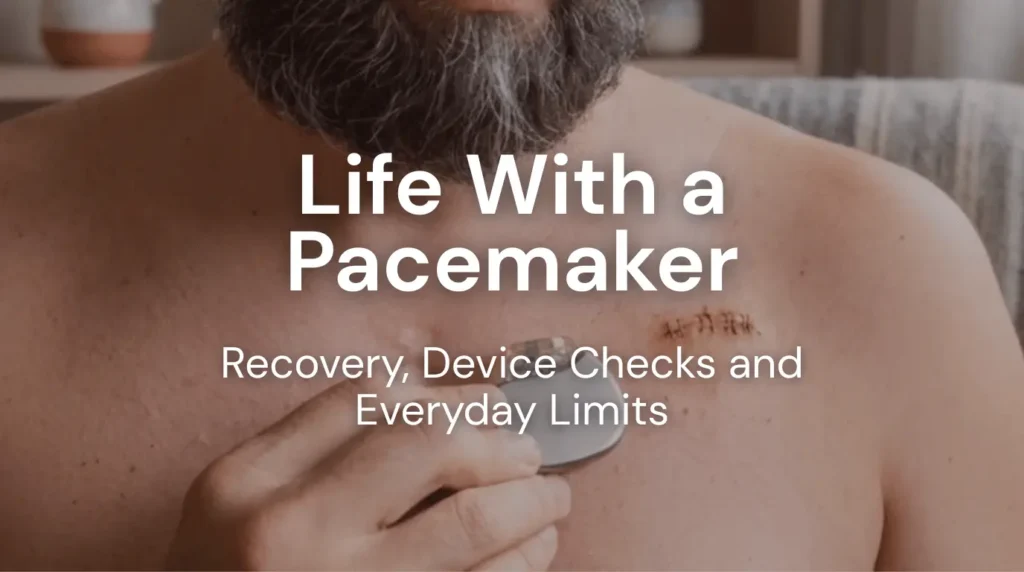
The wound. Expect some bruising and tenderness over the device, and a firm ridge where the generator sits. You can shower with the waterproof dressing in place. Do not remove the dressing unless you are instructed to, do not pick at it, and do not apply creams to the incision unless you have been told to.
Signs that need a call rather than a wait. Increasing redness spreading from the wound, discharge, a fever, the wound opening, or the device area becoming increasingly swollen or painful after the first days. Infection of an implanted device is uncommon, but it is not something to manage at home, and early assessment matters.
The arm. The restriction is to avoid lifting the arm on the implant side above shoulder height, and to avoid heavy lifting — anything over 10kg — or pulling on that side, for the first two weeks while the leads settle. Gentle normal movement of the arm is encouraged rather than discouraged: keeping it completely still risks a stiff shoulder, which is a more common problem than lead displacement.
Everyday activity. Walking is usually encouraged from the outset. Most patients return to desk-based work within one to two weeks and to more physical work later, depending on what the job demands of the affected arm.
Getting back to exercise
Exercise after a pacemaker is a question of sequencing rather than permission. Walking early, then a gradual return to general aerobic activity once the wound has healed, then upper-body and contact activity last, because those are the ones that load the device pocket and the leads.
Two specific cautions are worth naming. Contact sports carry a risk of a direct blow to the device, and activities involving repetitive heavy overhead arm movement on the implant side can, over years, stress the leads. Neither is a blanket ban.
There is no fixed timeframe after which everything is permitted again. Asian Heart & Vascular Centre sets this patient by patient, because what matters is the specific activity, the arm it loads and how your leads are performing — not a date on a calendar. Bring the activity you actually want to return to, and ask about that.
A pacemaker does not limit aerobic capacity in itself. Modern devices include rate-response features designed to raise the paced rate during exertion, which is precisely the problem being solved for patients whose own rate failed to rise on activity.
Everyday equipment: what is actually a problem
This is where patients receive the most outdated advice, often from relatives recalling guidance from decades ago. Modern devices are well shielded, and the practical list of concerns is short.
Safe in normal use: mobile phones, tablets and laptops; microwave ovens; household appliances; wifi and Bluetooth; airport walk-through metal detectors; electric blankets; hair dryers; induction hobs; televisions and remote controls.
Genuinely worth avoiding or discussing first: strong industrial magnetic fields, arc welding, and some electrical industrial equipment. If your work involves any of these, it needs a specific conversation rather than a general reassurance.
Airport security. Walk-through archways are not a problem. Carry your device identification card and tell the officer you have a cardiac device, as the usual request is that they avoid holding a hand-held wand directly over the device for a prolonged period. Nobody should be asking you to avoid flying.
Medical and dental procedures. Always tell any clinician, including your dentist, that you have a cardiac device. Routine dental treatment is not a problem. Some medical equipment, in particular surgical diathermy used during operations, radiotherapy, and certain nerve or muscle stimulation treatments, requires the device to be considered in planning, and sometimes reprogrammed beforehand. This is routine when it is known about in advance.
Can you have an MRI with a pacemaker?
Yes, in almost all cases, with planning. This deserves a direct answer because the old blanket prohibition still circulates and leads patients to decline scans they need.
Many contemporary devices and leads are designated MRI-conditional, meaning they may be scanned within specified conditions. Where a device is not MRI-conditional, scanning is still frequently possible under a protocol. In a prospective registry of 1,509 patients with non-MRI-conditional pacemakers and defibrillators undergoing clinically indicated non-thoracic scans at 1.5 tesla, with appropriate screening and the device reprogrammed to a prespecified protocol, no device or lead failures occurred.
The limits of that evidence should be stated plainly rather than glossed. The registry examined non-thoracic scans at 1.5 tesla, and excluded devices implanted before 2001 and pacing-dependent patients with defibrillators. It is evidence that a managed pathway is safe within those bounds, in centres with experience of scanning older devices — not that any patient can have any scan anywhere.
The practical point for patients: never simply decline an MRI, and never assume you can walk into one. Tell the requesting doctor and the radiology department that you have a cardiac device, and let the device team confirm the pathway. The device model and lead details are on your identification card, which is what the radiology team needs.
Device checks and remote monitoring
A pacemaker is checked periodically for the life of the device. A check involves placing a programmer head over the device to interrogate it, which is painless and takes a short appointment. What is being reviewed is the battery status, the electrical performance of each lead, the proportion of time the device has actually been pacing, and any rhythm episodes it has recorded.
That last item is often more clinically useful than patients expect. The device is a continuous rhythm monitor, so it may reveal episodes of atrial fibrillation or other arrhythmia that were never symptomatic, and that finding can change treatment independently of the pacing itself.
Remote monitoring is now standard practice with most contemporary devices. A bedside or mobile transmitter sends data automatically, which reduces the number of in-person appointments and, more importantly, means the clinic can be alerted to a technical issue or a recorded arrhythmia between visits rather than at the next appointment.
How often you are seen, and whether remote monitoring is used, is set by your own doctor rather than by a standard schedule. It depends on the device, how much it is pacing and what it has recorded, which is why two patients with the same implant can be on quite different follow-up intervals. Your first follow-up appointment is the point at which yours is set.
Battery replacement
A pacemaker battery is not replaced on its own. When it approaches the end of its life, the generator, which contains the battery and the circuitry as a sealed unit, is exchanged. The existing leads are usually left in place and reconnected to the new generator, provided testing shows they are performing well.
This matters because it makes a generator change a smaller procedure than the original implant. The pocket already exists and the leads do not need to be repositioned, so the operation is shorter and there is no new lead to settle, which is why the arm restrictions afterwards are usually less onerous than after a first implant. The replacement is usually done as day surgery.
Battery life depends on how much the device is actually pacing, which is why two patients with the same device can need replacement years apart, but modern batteries should last more than ten years for most patients. The device does not stop without warning. Depletion is detected at routine checks well in advance, and the device enters a predictable reserve mode, so replacement is planned rather than urgent.
Leads can occasionally fail or need replacing independently of the battery, which is a different and less common procedure.
When to contact the clinic
Most patients live with a device for years without incident. The symptoms that warrant contact rather than waiting for the next appointment:
- Return of the symptoms the device was implanted to treat, in particular fainting, near-fainting or the breathlessness and fatigue that preceded it
- Persistent hiccup-like twitching of the chest wall or diaphragm, which can indicate a lead issue
- Wound or device-site problems at any stage: redness spreading, discharge, swelling, or the device feeling as though it is moving or eroding through the skin
- A shock from a defibrillator, where you have one rather than a pacemaker alone
- A new fast, irregular, or racing heartbeat
- Fever without an obvious cause, given the implanted hardware
If any of these apply, contact any Asian Heart & Vascular Centre clinic and ask to bring your appointment forward. You do not need to wait for the next scheduled check.
Frequently asked questions
How long does it take to recover from a pacemaker?
The wound usually heals over one to two weeks, and most patients resume normal daily activity in that period. The restriction on raising the arm on the implant side above shoulder height, and on lifting anything over 10kg with it, is held for two weeks while the leads anchor into the heart wall.
When can I lift my arm above my head after a pacemaker?
After two weeks, once the leads have anchored. Until then, avoid raising the arm on the implant side above shoulder height and avoid lifting more than 10kg with it. Gentle normal movement below shoulder height is encouraged, because immobilising the shoulder entirely risks stiffness, which is more common than a displaced lead.
Can I have an MRI with a pacemaker?
Almost always yes, with planning. Many devices are MRI-conditional and can be scanned within set conditions. Where a device is not, scanning is often still possible under a managed protocol at a centre experienced with older devices. Always tell the requesting doctor and radiology department about your device rather than declining the scan.
Will a pacemaker set off airport security?
Walk-through metal detector archways are not a problem for the device. Carry your device identification card and tell the security officer you have a cardiac device, as the usual precaution is avoiding a prolonged sweep of a hand-held wand directly over it. A pacemaker is not a reason to avoid flying.
Can I use a mobile phone with a pacemaker?
Yes, in normal use. Modern pacemakers are well shielded, and phones, tablets, laptops, wifi and Bluetooth are all safe. So are microwaves, induction hobs, hair dryers, electric blankets and household appliances. The equipment that genuinely warrants a conversation first is industrial: strong magnetic fields, arc welding and some heavy electrical plant.
How long does a pacemaker battery last?
More than ten years for most patients with a modern device. The exact figure depends on how much the device is actually pacing, so two patients with identical devices can need replacement years apart. The device does not fail without warning: depletion is identified at routine checks well ahead of time and replacement is planned.
How often do I need a pacemaker check?
That is set by your own doctor rather than by a standard interval, and depends on your device, how much it is pacing and what it has recorded. Checks review battery status, lead performance and any rhythm episodes. Remote monitoring from home is standard with most contemporary devices and reduces in-person visits.
Is replacing a pacemaker the same operation as the first one?
It is smaller, and usually done as day surgery. The generator, containing the battery and circuitry as a sealed unit, is exchanged while the existing leads are usually retained and reconnected after testing. Because the pocket already exists and no new lead needs to settle, the restrictions afterwards are lighter.
If you have a pacemaker and something about it has changed, or you are due a review, Dr Pipin Kojodjojo at Asian Heart & Vascular Centre can check the device, review what it has recorded, and talk through what it means for your day-to-day life.
References
- Glikson M, Nielsen JC, Kronborg MB, Michowitz Y, et al. 2021 ESC Guidelines on cardiac pacing and cardiac resynchronization therapy. European Heart Journal. 2021;42(35):3427-3520. doi:10.1093/eurheartj/ehab364
- Russo RJ, Costa HS, Silva PD, et al. Safety of Magnetic Resonance Imaging in Patients with Cardiac Devices. New England Journal of Medicine. 2017;376(8):755-764. doi:10.1056/NEJMoa1604267