
By Dr Pipin Kojodjojo, consultant cardiologist and electrophysiologist, Asian Heart & Vascular Centre (AHVC). Last reviewed June 2026. Reading time: about 7 minutes.
The Medtronic Affera system combines high-density cardiac mapping with a focal dual-energy catheter that can deliver pulsed field ablation (PFA) or radiofrequency (RF) energy. AHVC reports that its doctors were the first to use Affera for AF ablation in Singapore private practice. The same catheter can support pulmonary vein isolation and selected additional RF lesions when clinically indicated.
What is the Medtronic Affera system?
Affera is an integrated mapping and ablation platform used by electrophysiologists to treat complex heart-rhythm disorders. Its unique Sphere-9 catheter can map electrical activity and deliver either PFA or RF energy without changing the catheter.
For atrial fibrillation, PFA can be used to isolate the pulmonary veins, which are common sources of AF triggers. When an additional line such as a cavotricuspid isthmus (CTI) line is clinically needed for typical atrial flutter, the same catheter can deliver RF energy. The treatment plan still depends on the patient’s rhythm, anatomy, and the electrophysiologist’s choice of which energy source is better suited for that ablation
AHVC’s Affera experience in Singapore
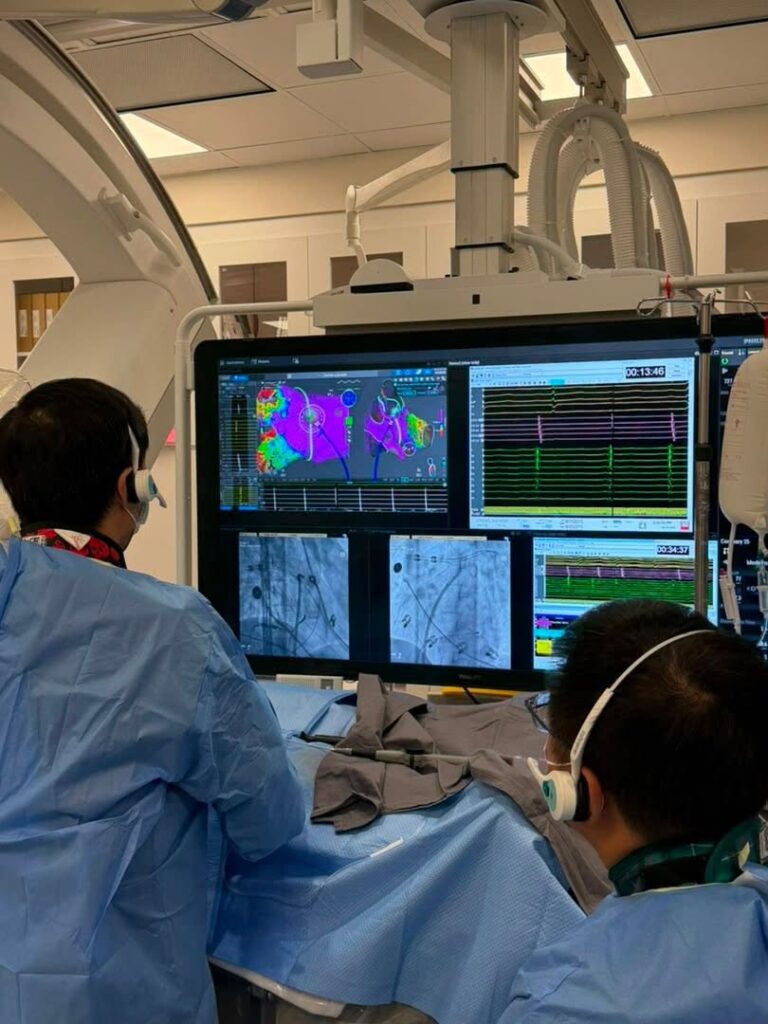
The electrophysiologists at AHVC were the first to perform AF ablation using Medtronic Affera in a Singapore private hospital. The procedure was completed seamlessly, without complications, and achieved a good immediate clinical result.
A successful first procedure is encouraging, but it does not prove which system provides better long-term outcomes. Patients should ask which technology best fits their AF type, whether additional lesions are expected, and what follow-up will be used to assess recurrence.
How is Affera different from a single-shot PFA system?
Single-shot PFA catheters are designed mainly to isolate pulmonary veins efficiently. Affera uses a focal catheter, allowing the operator to map, deliver PFA, and switch to RF for selected lesions without changing the ablation catheter.
· Integrated mapping: the catheter records detailed electrical information to guide treatment. Previously a separate high density mapping catheter was needed to collect such detailed information. The Sphere-9 catheter can provide this information and perform ablation
· Dual energy: the operator can select PFA or RF according to the target tissue and treatment plan.
· Focal control: individual lesions can be placed with precision rather than treating a large area of the heart with conventional single-shot catheters.
· Fewer catheter exchanges: the whole procedure can be completed with the same catheter, which speeds up the procedure and misses the risk of air entering the heart through exchanging catheters.
These are workflow and technical capabilities, not a guarantee of a shorter procedure, fewer complications, or freedom from AF. Clinical outcomes depend more on the patient characteristics, AF type, lesion durability, operator experience, and management of risk factors.
What are PFA and RF ablation?
Pulsed field ablation (PFA)
PFA uses brief high voltage electrical pulses to treat targeted heart-muscle cells through electroporation. It is non-thermal (does not heat up or cool the heart) and is designed to avoid injury to nearby structures compared with heat-based ablation. Clinical trials show PFA is an effective alternative to conventional thermal ablation for selected patients, with much, smaller risks of complications.
Radiofrequency (RF) ablation
RF ablation uses heat to create lesions that block abnormal electrical pathways. It has decades of clinical evidence and remains useful when the treatment plan requires focal lesions or extensive treatment beyond pulmonary vein isolation.
Who may benefit from Affera-guided AF ablation?
Catheter ablation may be discussed when AF causes symptoms, medication is ineffective or poorly tolerated, or rhythm control is preferred after shared decision-making. A flexible focal system may be particularly relevant when mapping identifies targets beyond straightforward pulmonary vein isolation or when AF recurs after a previous ablation.
Recurrence does not automatically mean Affera is the right next step. The electrophysiologist must determine why AF returned, whether pulmonary veins have reconnected, and whether another rhythm such as atrial flutter is present.
What happens during AF ablation?
1. Thin catheters are passed through a vein in the groin to the heart under sedation or general anaesthesia.
2. The electrophysiologist reaches the left atrium through a controlled puncture between the atria and the electrical activity of both atria is assessed by detailed mapping and testing
3. For patients undergoing their first ablation procedure, pulmonary vein isolation is performed using the selected technology. Additional lesions are created only when clinically indicated.
4. The team checks the result, removes the catheters, and monitors the patient during recovery.
Many patients go home the same day or after an overnight stay. The actual procedure time can vary but can be as short as 1 hour. . Anticoagulation is usually continued for a few months and longer if the patient’s stroke risk warrants it; patients should never stop it without medical advice.
How effective is AF ablation?
AF ablation is effective at reducing arrhythmia recurrence and improving quality of life in suitable patients. Success is generally higher for paroxysmal (early stage) AF than for persistent or long-standing persistent (late stage) AF, and a minority of patients need repeat treatment.
Trials of PFA and the Affera platform support their effectiveness, but percentages from a study cannot predict an individual patient’s result. The doctor will explain how to monitor for AF recurrence and what the expected success rate for your AF would be.
What are the risks?
AF ablation is minimally invasive and one of the safest heart procedures.. Potential complications include bleeding or vascular injury at the groin, fluid or bleeding around the heart, , and rare complications related to anaesthesia.
The most useful safety discussion is personal: your electrophysiologist should explain the expected benefits, alternatives, the centre’s experience, and risks relevant to your health and planned lesion set.
Frequently asked questions
Is Affera the same as pulsed field ablation?
Affera is a mapping and ablation system. Its Sphere-9 catheter can deliver PFA and RF energy, so PFA is one capability of the system rather than its full definition.
Can one Affera catheter perform PVI and a CTI line?
The catheter can deliver PFA for pulmonary vein isolation and RF for a CTI line without changing the ablation catheter when both are clinically indicated.
Is Affera better than a single-shot PFA system?
The systems have different designs and workflows. The best choice depends on the rhythm problem, anatomy, required lesion set, operator experience, and available evidence.
Is PFA risk-free?
No. PFA avoids heating tissue and can avoid all thermal-injury risks, but vascular injury, tamponade, coronary spasm, and other rare complications remain possible.
Can Affera help if AF returns after an earlier ablation?
It may be an option, particularly when detailed remapping or additional lesions are needed. A repeat procedure should follow an individual assessment of the reason for recurrence.
Discuss AF ablation in Singapore
AHVC’s electrophysiology team can assess whether catheter ablation is appropriate and explain which available technology fits the planned treatment. Bringing new technologies into practice is valuable when they support a clear clinical need and are used with careful patient selection and follow-up.