
Reviewed by Dr Edgar Tay, interventional cardiologist and structural heart specialist at Asian Heart & Vascular Centre.
Last reviewed September 2026.
Reading time: about 10 minutes.
TL;DR
Long flights do raise the risk of a blood clot, and the honest version of that sentence needs both halves of the arithmetic. Relative to not travelling, the risk roughly doubles or triples after journeys of four hours or more. In absolute terms it stays low: a cohort of 8,755 employees recorded one symptomatic clot per 4,656 long-haul flights, and the World Health Organization puts it at around one in 6,000. European guidance grades prolonged sitting a weak risk factor, and risk concentrates in people who already have a reason to clot. For travellers leaving Singapore, moving regularly and, where indicated, correctly fitted graduated compression stockings are what the evidence supports. Aspirin is not recommended.
The question people actually ask before a long flight
It usually arrives a week before departure. Thirteen hours to London, a colleague who came off a plane with a swollen calf, a rack of flight socks in the chemist at Changi, a relative suggesting an aspirin before boarding. None of it comes with an explanation.
The worry underneath is a clot in a deep leg vein, called deep vein thrombosis or DVT, and the chance that part of it travels to the lungs, called pulmonary embolism or PE. Both are presentations of one condition, venous thromboembolism or VTE, explained on the pulmonary embolism page and in our guide to DVT and pulmonary embolism treatment in Singapore.
This article answers the narrower question: what travel does to the risk, who it matters to, and which precautions the evidence supports.
What the evidence says about flights and clots, with the absolute numbers
Almost every unhelpful conversation here comes from mixing up two numbers. Relative risk is how much travel multiplies your chance of a clot; absolute risk is what that chance actually is. A large multiplier on a very small number still produces a small number.
The relative risk is real and measurable. A meta-analysis of 14 studies covering 4,055 cases of venous thromboembolism found a pooled relative risk of 2.0 in travellers against non-travellers, rising to 2.8 once studies using referred controls were excluded, and a dose-response relationship: 18 per cent higher risk for each additional two hours of travel by any mode, and 26 per cent for every two hours of air travel. Duration matters more than the aircraft does.
The absolute risk is low. A prospective cohort followed 8,755 employees of international organisations through 38,910 person-years and 100,208 long-haul flights. Fifty-three thromboses occurred, 22 within eight weeks of a long-haul flight. That is one event per 4,656 long-haul flights, or 3.2 per 1,000 person-years in the eight weeks after a flight against 1.0 with no recent air travel. The World Health Organization’s WRIGHT project, which commissioned that work, puts the risk to a traveller seated and immobile for more than four hours at about one in 6,000.
Four hours is the threshold the evidence uses: the definition of a long-haul flight in that cohort and the cut-off in both American College of Chest Physicians and American Society of Hematology guidance. It is a practical dividing line, not a biological switch, and risk keeps climbing past it.
Set against other causes, travel is a minor one. The 2019 European Society of Cardiology guidelines on acute pulmonary embolism grade predisposing factors by odds ratio, and immobility due to sitting, including prolonged car or air travel, sits in the weak category below an odds ratio of 2.
“Economy class syndrome” is the wrong name for it. The phrase implies legroom is the mechanism, and the data do not support that. Among passengers who had flown more than four hours in the previous eight weeks, business class carried an odds ratio of 0.7 on a confidence interval from 0.2 to 1.8 that includes no effect, while a window seat rather than an aisle seat doubled the risk, odds ratio 2.2. That describes how easily a passenger can get up, not the fare.
Why does sitting still cause blood clots?
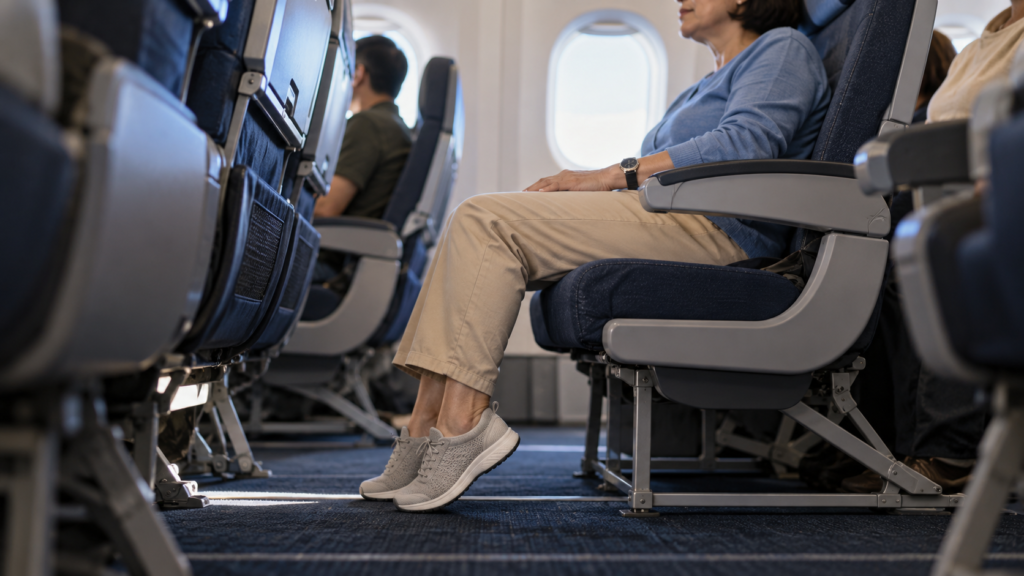
Blood returning from the legs works against gravity, and the heart is not what pushes it. The calf muscles do. Each contraction squeezes the deep veins and drives blood upward past one-way valves. That is the calf muscle pump, and it runs while you walk. Sit still for hours with the knees bent and it stops, blood in the deep calf veins pools, and slow-moving blood is where venous clots form.
Two popular explanations are weaker than they sound. The first is cabin pressure. A crossover study put 73 healthy volunteers through eight hours seated in a hypobaric chamber against a normobaric exposure, and concluded that hypobaric hypoxia of the degree encountered on long-haul flights does not cause prothrombotic changes in healthy people at low risk of venous thromboembolism.
The second is dehydration. That same study found no effect of alcohol on risk, odds ratio 1.1, and no protective effect from drinking non-alcoholic beverages. Staying hydrated is sensible, but presenting it as the main defence overstates what has been shown.
Who is most at risk of a clot when flying?
Risk is not spread evenly across a cabin. The European Society of Cardiology grades the contributing factors. Strong, above an odds ratio of 10: a previous venous thromboembolism, fracture of a lower limb, hip or knee replacement, major trauma. Moderate, 2 to 9: cancer and chemotherapy, oral contraceptive therapy, hormone replacement therapy, the post-partum period, thrombophilia. Weak: prolonged sitting, pregnancy, obesity, increasing age. Pregnancy itself is graded weak while the post-partum period is graded moderate, so the window after delivery carries more weight than the pregnancy before it.
Recent surgery belongs in that strong group, and a meta-analysis of 24,975 surgical patients found adding a flight did not raise the risk further, at a pooled odds ratio of 1.96 whose confidence interval, 0.54 to 7.08, includes no effect. The operation is the risk; the flight is a timing question for the surgeon.
Hormonal contraception is a real factor whose size is misjudged in both directions. A network meta-analysis put the relative risk of venous thrombosis in combined oral contraceptive users at 3.5 against non-users, on a baseline incidence of 1.9 and 3.7 per 10,000 woman-years. Tripling a number that small leaves it small, which is why the finding does not on its own argue against flying or against the contraceptive.
The American Society of Hematology defines the group at substantially increased risk as people with recent surgery, a prior VTE, women who are post-partum, those with active malignancy, or anyone carrying two or more risk factors in combination. That definition is what a pre-travel conversation is for.
The Singapore context
Singapore is an unusual place to ask this question, because almost everyone here is a long-haul traveller. Changi connects the city to Europe, North America and Australia on sectors well past the four-hour threshold, and a large working population flies regional sectors monthly. The outbound-then-return pattern matters more than it looks: risk rose with the number of flights taken, by a factor of 1.4 per additional flight among those making five or more. Two long sectors a fortnight apart are not one exposure. Singapore also receives many patients who fly in from the region for care.
The local baseline is genuinely different. A systematic review of venous thromboembolism incidence across Asia, led from Singapore General Hospital, found population-wide annual incidences of 13.8, 15.9 and 19.9 per 100,000 in Korea, Taiwan and Hong Kong, roughly 15 to 20 per cent of Western levels. Every travel-thrombosis study in the major meta-analysis came from a Western country, and the authors said generalisability elsewhere needs confirmation. The multipliers above are therefore applied here to a lower starting number. That is a limit on the evidence rather than a finding, and it argues for less alarm rather than more.
What helps, and what does not
Moving is the intervention that follows from the mechanism. For travellers at increased risk, the American College of Chest Physicians suggests frequent walking, calf muscle exercise, or an aisle seat where possible. One caveat: the study of flight behaviour did not detect a protective effect from in-seat exercise. The recommendation rests on the mechanism and on costing nothing, not on trial proof.
Correctly fitted graduated compression stockings have the strongest trial evidence here, within clear limits. A Cochrane review of 12 randomised trials covering 2,918 passengers on flights over five hours found that of 2,637 participants with follow-up, 50 developed a symptomless DVT: three who wore stockings and 47 who did not, an odds ratio of 0.10, high-certainty evidence. The limit matters, and the reviewers state it: no deaths, pulmonary emboli or symptomatic DVTs occurred in any trial, so the effect on those outcomes cannot be assessed.
“Correctly fitted” is not a formality, and it is where most of the benefit is lost. It means four things.
They are graduated, with pressure highest at the ankle and decreasing up the leg. For travel the guidance specifies below-knee stockings delivering 15 to 30 mmHg at the ankle. A sports compression sock, or an unmarked flight sock sold by shoe size, is a different product and not what was tested.
They are sized from a measurement rather than a guess. UK national guidance on anti-embolism stockings is explicit that legs are measured, the correct size provided, fitting done by someone trained, and legs re-measured if they swell. A stocking too tight at the calf inverts the gradient and works against the leg.
They are not suitable for everyone. The same guidance advises against them in people with suspected or proven peripheral arterial disease or a bypass graft, peripheral neuropathy or other sensory impairment, severe leg swelling, fragile skin, dermatitis or a recent skin graft, or a leg shape preventing correct fit. That guidance covers hospital anti-embolism stockings, which sit at a lower pressure than travel stockings, but the safety reasoning transfers.
They come off if something goes wrong: skin marking, blistering, discolouration or pain means stop wearing them.
Aspirin is not recommended for preventing travel-related clots, and the reason is specific. The American College of Chest Physicians suggests against aspirin or anticoagulants for long-distance travellers, and the American Society of Hematology is equally clear for travellers without risk factors, suggesting neither stockings, nor low-molecular-weight heparin, nor aspirin. Aspirin acts on platelets, which are central to clots forming in fast-flowing arteries. A travel-related clot forms in slow-moving venous blood and is built largely of fibrin and trapped red cells, so the drug is aimed at the wrong part of the process. Against that, it carries a bleeding risk that does not switch off for the duration of a flight. Taking one before boarding is the most common piece of advice in this area, and it is not supported.
Prophylactic anticoagulation is a prescribing decision, not a travel tip. For travel over four hours by someone at substantially increased risk, guidance suggests graduated compression stockings or prophylactic low-molecular-weight heparin, and where neither is feasible it suggests aspirin rather than nothing at all. An injection before a flight is a prescription, weighed against that person’s bleeding risk by a doctor who knows them.
Can sitting at a desk all day cause blood clots?
If the mechanism is stasis rather than altitude, an office chair should behave like a seat in row 41, and it does. A case-control study of 197 patients with venous thromboembolism and 197 controls defined prolonged seated immobility as being seated at work and at the computer at home for at least 10 hours in a 24-hour period, and at least two hours at a time without getting up. That pattern was present in 16.8 per cent of cases against 9.6 per cent of controls, an adjusted odds ratio of 2.8. The two-hour block is the unit to break up, at 38,000 feet or at a desk in the Central Business District.
After the flight: what to watch for, and for how long
In the cohort study the risk was highest in the first two weeks after a long-haul flight, at 4.7 per 1,000 person-years, then fell and returned to baseline by eight weeks. The World Health Organization describes it as elevated for about four weeks, so the span to stay alert through is the month after landing.
In the leg, the pattern that matters is one-sided: swelling of one calf or thigh, pain or tenderness often worse on standing, warmth, and a change in skin colour over the swollen area. Both legs being puffy after a flight is common and usually reflects fluid. One leg visibly larger than the other is different, and warrants a medical assessment the same day.
In the chest, sudden breathlessness, chest pain sharper on breathing in, coughing up blood, feeling faint or collapsing suggest a clot has reached the lungs. That is an emergency department presentation, not a clinic booking, and Asian Heart & Vascular Centre is not the route for it. Call 995 or go to the nearest emergency department.
For anyone already told they have a clot, the pathway is covered in the guide to DVT and pulmonary embolism treatment in Singapore, and the condition on the thrombosis page. In a few people a venous clot reaches the brain through a small opening in the heart, covered in our guide to a hole in the heart (PFO).
When to see a doctor before you fly
Most people do not need to. For long-distance travellers without risk factors, guidance suggests neither stockings, nor low-molecular-weight heparin, nor aspirin, so a healthy traveller needs no appointment before a long flight.
A conversation beforehand is worth having if you have had a clot before, are having treatment for cancer, have had surgery or a lower-limb injury recently, are pregnant or within the weeks after delivery, have a known clotting disorder, or carry two or more of the factors above. You should leave knowing which risk tier you fall into, whether stockings are appropriate and at what pressure, whether prophylactic anticoagulation is warranted, and what symptoms afterwards would mean calling someone.
Who does this at Asian Heart & Vascular Centre
Dr Edgar Tay is an interventional cardiologist and structural heart specialist at AHVC, and pulmonary hypertension is among his sub-specialties. That is the relevant adjacency, because a small proportion of people who have had a pulmonary embolism develop chronic thromboembolic pulmonary hypertension, where organised clot material persists in the lung arteries and raises the pressure. Dr Tay performs balloon pulmonary angioplasty for CTEPH, the chronic end of this story. AHVC brings together 10 cardiologists across five hospital locations in Singapore, and a consultation covers history, risk stratification and the tests listed under cardiac investigations.
Should I see a cardiologist or a vascular surgeon for a blood clot?
It is worth being direct about where this stops. A travel risk question in an otherwise well person is usually answered by a general practitioner. Assessment of a suspected acute leg clot begins with an ultrasound of the leg veins, a vascular investigation rather than a cardiac one, and anticoagulation for a first clot is often managed by haematology or vascular surgery. Cardiology is the right door when the question sits alongside a known cardiac condition, when a previous pulmonary embolism has left ongoing breathlessness, or when chronic thromboembolic disease is considered. Where the answer is a referral elsewhere, that is how the consultation ends.
If you have had a clot before, or you carry a risk factor and you fly often, a consultation with Dr Edgar Tay at Asian Heart & Vascular Centre in Singapore can establish which of these recommendations apply to you and which do not.