
Reviewed by Dr Edgar Tay, interventional cardiologist and structural heart specialist at Asian Heart & Vascular Centre. Last reviewed August 2026.
Reading time: about 10 minutes.
TL;DR
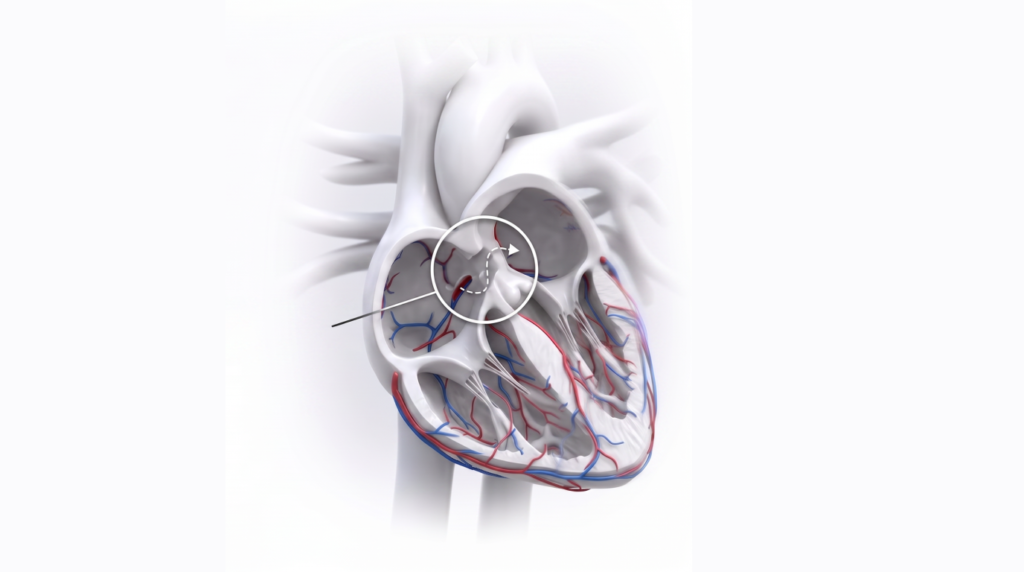
A patent foramen ovale (PFO) is a small flap-like opening between the two upper chambers of the heart that everyone has before birth and that fails to seal in roughly a quarter of adults [1]. For most people it never causes a problem and never needs treating. It matters in a narrow set of situations: after a stroke with no other explanation, in some divers, and occasionally where it causes low blood oxygen. The decision to close one is not automatic. It rests on whether the PFO is the most likely explanation for what happened, and international guidance sets out how that judgement is made [2, 3].
Being told you have a hole in the heart
Most people meet the words “hole in the heart” in one of two situations, and they are very different.
The first is after a scan that was done for another reason. An echocardiogram ordered for palpitations, a murmur or a pre-operative check picks up a small opening between the upper chambers, and it appears on the report as an incidental finding. Nothing has gone wrong. Nothing may ever go wrong.
The second is after a stroke, often in someone young and otherwise well, where the usual explanations do not fit. The arteries are clear, the rhythm is normal, the cholesterol is unremarkable, and the question becomes where the clot came from. In that situation a PFO stops being an anatomical curiosity and becomes a possible route.
The phrase covers the same anatomy in both cases. What differs is the significance, and that difference is the whole of the decision.
It is worth saying plainly that “hole in the heart” is a lay phrase covering several distinct conditions. A PFO is not the same as an atrial septal defect (ASD), although both sit in the wall between the upper chambers. An ASD is a true structural gap in that wall, present because the wall did not form completely. A PFO is a flap that is anatomically complete but unsealed, closed most of the time by the pressure difference between the two sides. The distinction matters because the two are managed differently.
What a PFO actually is, and why everyone starts with one
Before birth, the lungs are not doing any breathing. Oxygen arrives through the placenta, and blood needs a way to bypass the lungs entirely. The foramen ovale is that bypass: an opening in the wall between the right and left atria, held open by the pressure of blood arriving from the placenta.
At birth the first breath changes the pressures. Blood begins flowing through the lungs, pressure in the left atrium rises above the right, and the flap is pushed shut. In most people it then fuses over the following months and becomes a permanent seal.
In a substantial minority it never fuses. The flap stays functionally closed under normal conditions but remains capable of opening. The classic autopsy series of 965 normal hearts found an overall incidence of 27.3 per cent, falling with age from 34.3 per cent in the first three decades of life to 20.2 per cent in the ninth and tenth [1]. In that series the openings ranged from 1 to 19 mm, with a mean of just under 5 mm [1].
Two consequences follow from that anatomy.
It is common, so its presence proves nothing. If roughly one adult in four has a PFO, then finding one in a person who has had a stroke does not establish that it caused the stroke. Many people with a PFO and a stroke had the stroke for an unrelated reason and happen to have a PFO as well. Separating the two is the central clinical task.
It opens under specific conditions. Because the flap responds to pressure, it can open transiently when pressure in the right atrium rises above the left. Straining, coughing, lifting, bearing down, and the pressure changes of ascent from a dive all do this. That is when material in the venous circulation can cross to the arterial side instead of being filtered by the lungs, a mechanism called paradoxical embolism.
How a PFO is found, and why a normal echo does not settle it
A standard transthoracic echocardiogram, the scan performed through the chest wall, may show a PFO but frequently does not. The flap is closed at rest and there is nothing to see. A normal echocardiogram therefore does not exclude one.
Detection usually needs a provocation. Agitated saline (a bubble study) is injected into a vein while the patient performs a strain manoeuvre that briefly raises right-sided pressure. The saline is given through a small cannula in an arm vein, the same as for a routine blood test. If bubbles appear in the left-sided chambers, blood is crossing. The same principle applies to a transcranial Doppler study, which listens for bubbles reaching the brain circulation instead of looking for them in the heart, and which Asian Heart & Vascular Centre offers as part of the bubble contrast transcranial Doppler pathway.
A transoesophageal echocardiogram, performed with the probe in the oesophagus behind the heart, gives the clearest anatomical view and is often used when the size and shape of the opening will change the plan.
Reports sometimes describe a PFO by shunt grade, based on how many bubbles cross. A larger shunt, and one that crosses without any strain at all, generally carries more clinical weight than a few bubbles seen only on straining. Grade alone does not decide anything, but it forms part of the picture.
The Singapore context
Stroke in younger adults is not rare in Singapore, and it is investigated thoroughly here. Where the standard workup, brain and vessel imaging, prolonged rhythm monitoring, and blood tests for clotting disorders, comes back without an explanation, the stroke is classified as cryptogenic, meaning of unknown cause. That is the population in which a PFO becomes relevant.
Two local factors are worth naming. Singapore has a large recreational diving community with easy access to dive sites across the region, which makes the diving question a practical one rather than a theoretical one. And a considerable number of patients arrive here for assessment from Indonesia, the Philippines and elsewhere in the region, which means decisions often need to account for follow-up happening in another country. Both are addressed further down.
Assessment and closure are performed in Singapore by interventional cardiologists sub-specialising in structural heart disease. This is not general cardiology work; it requires specific training in transcatheter techniques and in the imaging that guides them.
Do you need it closed? How the decision is actually made
This is the question most people arrive with, and the honest answer is that most PFOs are left alone.
An incidental PFO with no clinical event is not usually treated. Where a PFO is found on a scan done for another reason, in someone who has never had a stroke, a transient ischaemic attack or unexplained low blood oxygen, current guidance does not support closing it [2, 3]. The risk of a first stroke attributable to a PFO in an otherwise well person is very low, and any procedure carries some risk. Closing a finding that was never going to cause trouble converts a non-problem into a small procedural risk.
After a cryptogenic stroke, the question becomes whether the PFO is the likely culprit. This is where the reasoning gets careful. Clinicians assess how plausible paradoxical embolism is as the mechanism, and one of the tools used is the RoPE score, a ten-point system based on age and vascular risk factors in which higher scores indicate a greater probability that the PFO is causally related rather than incidental [2]. A young patient with no hypertension, no diabetes, no smoking history and a cortical infarct scores highly. An older patient with several vascular risk factors scores low, because in that person the stroke has other plausible explanations and the PFO is more likely to be a bystander.
The anatomy contributes as well. A large shunt, or an associated atrial septal aneurysm, strengthens the case. So does a clear provoking event, for instance a long flight or heavy straining immediately before the stroke, or evidence of deep vein thrombosis providing a source for the clot.
Three randomised trials changed practice in 2017. CLOSE, RESPECT and REDUCE each compared closure plus medical therapy against medical therapy alone in patients with cryptogenic stroke and a PFO, and were published together [4, 5]. In selected patients, meaning younger patients with anatomically significant PFOs and no other explanation for the stroke, closure reduced recurrent stroke more than medical therapy alone. Five-year follow-up has since been reported [6]. Those trials are the reason closure is offered at all, and the reason it is offered only to a defined group. The trials selected their patients carefully, and the benefit demonstrated applies to patients who resemble those enrolled.
European and American guidance now sets out this selection process in detail, including how it should be reached jointly by cardiology and neurology rather than by either alone [2, 3, 7].
Medication is the alternative, not simply the fallback. Antiplatelet therapy, and in some circumstances anticoagulation, is a legitimate treatment for the same problem. For a patient whose RoPE score is low, whose anatomy is unremarkable, or who has other reasons to avoid a procedure, medical therapy is the appropriate answer rather than a compromise.
The order things happen in
The sequence matters, and skipping steps produces the wrong answer.
- Establish that the stroke is genuinely unexplained. This means completing the workup, including prolonged rhythm monitoring to look for atrial fibrillation, which is a far more common cause and is treated entirely differently. A PFO found before the rhythm has been properly assessed is a premature conclusion.
- Characterise the PFO. Size, shunt volume, whether it crosses at rest, and the surrounding anatomy.
- Assess causal plausibility. RoPE score, the clinical circumstances, any evidence of venous clot.
- Decide jointly. Neurology and cardiology together, because the question spans both.
- Only then discuss the procedure itself. Details of the device and the transcatheter technique are covered on the PFO device closure service page.
For an incidental PFO with no event, the sequence usually stops at step two, with an explanation and reassurance.
Diving, flying, altitude and sport
This is the question divers ask, and it deserves a direct answer.
A PFO is associated with an increased risk of decompression sickness, particularly the forms affecting the brain, skin and inner ear. Nitrogen bubbles that form in the venous circulation during ascent are normally filtered by the lungs. A PFO offers a route past that filter. European guidance addresses diving specifically as one of the situations outside stroke where a PFO may warrant intervention [7].
Several points follow, and they are practical rather than absolute.
- Routine screening of all divers is not recommended. The relevant guidance does not support testing every diver for a PFO.
- Testing becomes reasonable after unexplained decompression sickness, especially where the dive profile was conservative and the illness affected the brain, inner ear or skin.
- Conservative diving practice reduces risk without any procedure. Shallower profiles, longer ascent times, longer surface intervals and avoiding heavy exertion or straining after a dive all reduce bubble load.
- Closure is one option among several for a diver who has had decompression sickness and wants to continue diving, and it is a conversation about that individual’s diving pattern and priorities rather than a standard recommendation.
Commercial flying is not a comparable exposure and does not require any restriction. Altitude and trekking do not, in themselves, warrant a PFO assessment. Competitive sport is generally unaffected, although the strain involved in heavy resistance training is the kind of pressure change that opens a flap, which is worth mentioning in a consultation if it applies to you.
What to expect, honestly
If your PFO is incidental and staying open. Most people need no follow-up scans, no medication for the PFO itself, and no restrictions. It does not enlarge over time in any clinically meaningful way, it does not weaken the heart, and it does not require telling a dentist or altering routine care. Ordinary cardiovascular risk factors still deserve attention, because they matter far more to your long-term health than the PFO does.
If closure is being considered after a stroke. Expect the assessment to take more than one visit, because it depends on tests that take time, particularly prolonged rhythm monitoring. Expect the discussion to involve a neurologist. And expect a genuine choice to be presented, since medical therapy remains a reasonable option for many patients.
If a PFO has been ruled out as the cause. This is a common and frustrating outcome. The stroke remains unexplained, the PFO remains present, and the plan is medical. That is a defensible answer supported by the same guidance that supports closure in other patients.
On migraine. Many patients ask, because the association between PFO and migraine with aura is real and widely discussed. The evidence for closure as a migraine treatment is not there. The randomised trials, including PREMIUM, did not meet their primary endpoints, although secondary measures such as headache days showed some improvement [8], and a later pooled analysis examined the combined data [9]. Migraine alone is not currently an indication for closing a PFO.
What a consultation involves
Bring the actual reports rather than a summary. The echocardiogram images and report, any brain imaging, the discharge summary if there was an admission, and any rhythm monitoring results are the material the decision is built on. Where a PFO was found incidentally, bring the report that mentioned it and the reason the scan was ordered in the first place.
Useful questions to ask:
- Is this PFO the likely explanation for what happened to me, or an incidental finding?
- Has atrial fibrillation been properly excluded?
- What would happen if we did nothing?
- If I choose medication instead, what does that involve long term?
- Who else is involved in this decision?
For patients travelling to Singapore from elsewhere in the region, raise follow-up arrangements at the first consultation rather than the last. Where closure is performed, there is a follow-up schedule and a period on antiplatelet medication afterwards, and both need to work in the country where you live.
Who does this at Asian Heart & Vascular Centre
PFO assessment and transcatheter closure sit within structural heart intervention. At Asian Heart & Vascular Centre this is led by Dr Edgar Tay, interventional cardiologist and structural heart specialist, whose practice covers device closure of the interatrial septum alongside valve intervention. Where the presentation is primarily a rhythm question, for instance where atrial fibrillation is suspected as the true cause of a stroke, assessment involves the electrophysiology team, and PFO decisions are sometimes reached jointly across both.
Diagnostic work, including bubble contrast studies and transcranial Doppler, is performed in-house, and the procedural detail for closure itself is set out on the PFO device closure page.
If you have been told you have a hole in the heart and you are not sure whether it matters, that is a reasonable question and it has a specific answer. A consultation with Dr Edgar Tay at Asian Heart & Vascular Centre can establish whether the finding explains anything that has happened to you, whether it needs treating, and what the alternatives are if it does.
References
- Hagen PT, Scholz DG, Edwards WD. Incidence and size of patent foramen ovale during the first 10 decades of life: an autopsy study of 965 normal hearts. Mayo Clinic Proceedings. 1984;59(1):17-20.
- Pristipino C, Sievert H, D’Ascenzo F, et al. European position paper on the management of patients with patent foramen ovale. General approach and left circulation thromboembolism. European Heart Journal. 2019;40(38):3182-3195.
- Caso V, Turc G, Abdul-Rahim AH, et al. European Stroke Organisation (ESO) guidelines on the diagnosis and management of patent foramen ovale (PFO) after stroke. European Stroke Journal. 2024. doi:10.1177/23969873241247978
- Søndergaard L, Kasner SE, Rhodes JF, et al. Patent foramen ovale closure or antiplatelet therapy for cryptogenic stroke (REDUCE). New England Journal of Medicine. 2017;377:1033-1042. doi:10.1056/NEJMoa1707404
- Saver JL, Carroll JD, Thaler DE, et al. Long-term outcomes of patent foramen ovale closure or medical therapy after stroke (RESPECT). New England Journal of Medicine. 2017;377:1022-1032. doi:10.1056/NEJMoa1610057
- Kasner SE, Rhodes JF, Andersen G, et al. Five-year outcomes of PFO closure or antiplatelet therapy for cryptogenic stroke. New England Journal of Medicine. 2021. doi:10.1056/NEJMc2033779
- Pristipino C, Germonpré P, Toni D, et al. European position paper on the management of patients with patent foramen ovale. Part II: decompression sickness, migraine, arterial deoxygenation syndromes and select high-risk clinical conditions. EuroIntervention. 2021.
- Tobis JM, Charles A, Silberstein SD, et al. Percutaneous closure of patent foramen ovale in patients with migraine: the PREMIUM trial. Journal of the American College of Cardiology. 2017;70(22):2766-2774. doi:10.1016/j.jacc.2017.09.1105
- Mojadidi MK, Kumar P, Mahmoud AN, et al. Pooled analysis of PFO occluder device trials in patients with PFO and migraine. Journal of the American College of Cardiology. 2021;77(6):667-676. doi:10.1016/j.jacc.2020.11.068
Frequently Asked Questions
What is a hole in the heart?
A patent foramen ovale, or PFO, is a small flap-like opening between the two upper chambers of the heart. Everyone has one before birth, when it allows blood to bypass the lungs. In most people it seals after birth. In roughly a quarter of adults it does not.
Is a PFO the same as a hole in the heart?
A PFO is one kind of hole in the heart, but the phrase covers several conditions. A PFO is a flap that is anatomically complete but unsealed. An atrial septal defect is a true gap in the wall between the chambers because it never formed completely. The two are managed differently.
How common is a PFO?
Common. An autopsy study of 965 normal hearts found an overall incidence of 27.3 per cent, falling with age from 34.3 per cent in the first three decades of life to 20.2 per cent in the ninth and tenth. Because it is this common, finding one proves nothing on its own.
Can a normal echocardiogram miss a PFO?
Yes. A standard echocardiogram through the chest wall often shows nothing, because the flap sits closed at rest. Detection usually needs a provocation, such as an agitated saline bubble study performed while straining. A normal echocardiogram does not exclude a PFO.
Do I need my PFO closed?
Most PFOs are left alone. Where one is found incidentally in someone who has never had a stroke, a transient ischaemic attack or unexplained low blood oxygen, current guidance does not support closing it. Closure is considered mainly after a stroke with no other explanation.
What happens if you do not close a PFO?
For most people, nothing. An incidental PFO needs no follow-up scans, no medication for the PFO itself and no restrictions. It does not enlarge meaningfully over time and it does not weaken the heart. Ordinary cardiovascular risk factors matter far more to long-term health.
What is recovery like after PFO closure?
Recovery specifics, along with the device and the transcatheter technique, are set out on our PFO device closure service page. Closure is followed by a defined follow-up schedule and a period on antiplatelet medication, both of which are planned before the procedure.
Can I scuba dive with a PFO?
A PFO is associated with a higher risk of decompression sickness, because nitrogen bubbles that form on ascent can bypass the lung filter. Routine screening of all divers is not recommended. Testing becomes reasonable after unexplained decompression sickness, particularly where it affected the brain, inner ear or skin.
Does closing a PFO help migraine?
On current evidence, not reliably. The randomised trials, including PREMIUM, did not meet their primary endpoints, although some secondary measures such as monthly headache days improved. Migraine on its own is not an indication for closing a PFO.
Which doctor treats a hole in the heart in Singapore?
PFO assessment and transcatheter closure sit within structural heart intervention. At Asian Heart & Vascular Centre this is led by Dr Edgar Tay, interventional cardiologist and structural heart specialist. Where a rhythm problem is the suspected cause of a stroke, the electrophysiology team is involved as well.